
EIZO ColorEdge CG2400S 24.1" Full HD HDR Monitor

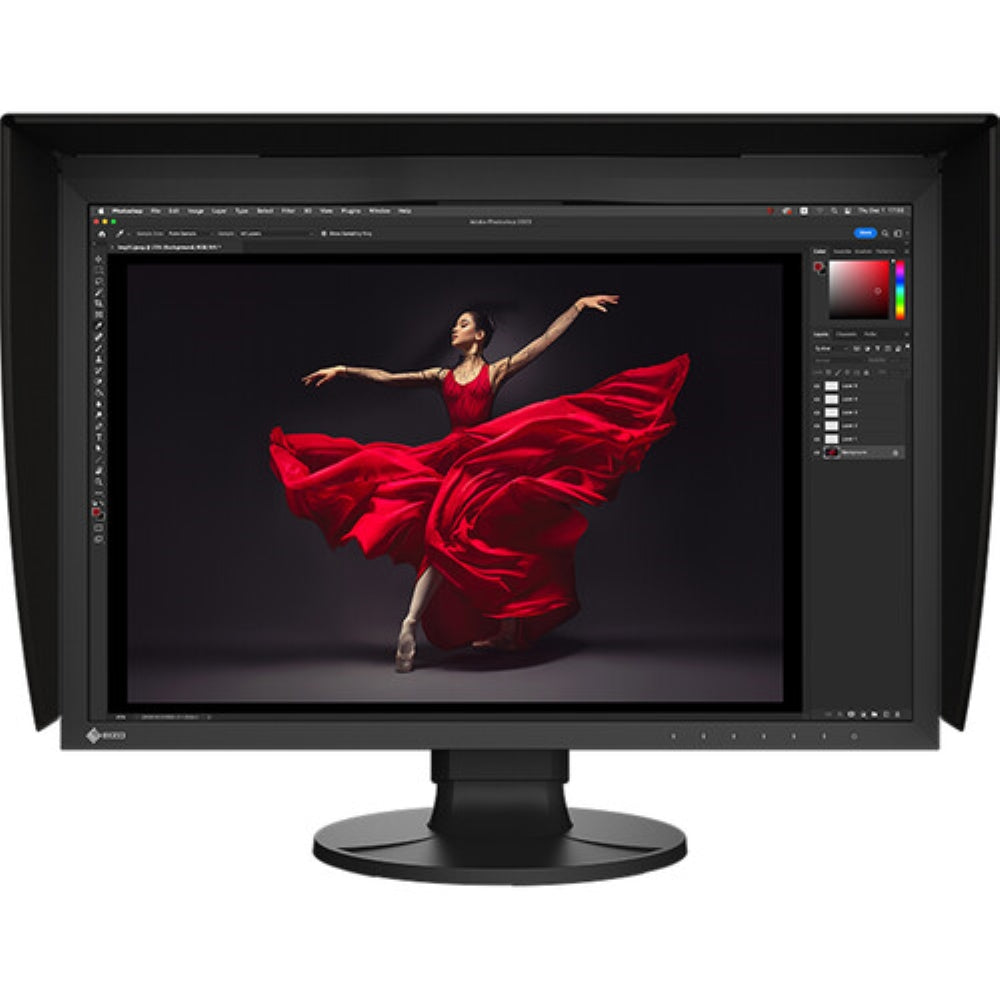
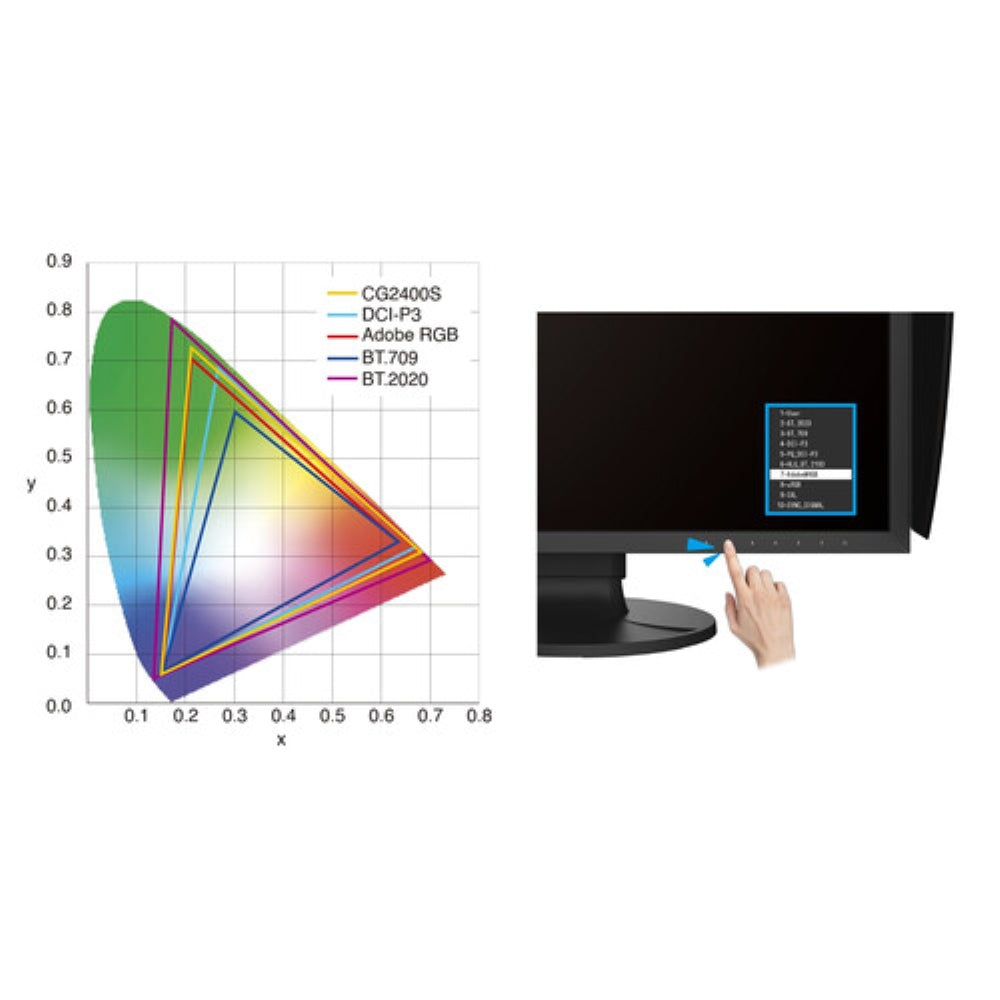
Primarily intended for professional video and photo editing, the EIZO ColorEdge CG2400S 24.1" Full HD HDR Monitor provides precise color reproduction and flexible connectivity options. Featuring an integrated color calibrator and supporting 99% Adobe RGB and 98% DCI-P3 color spaces, this compact display with a resolution of 1920 x 1200 is equipped to assist in realizing your creative aspirations.
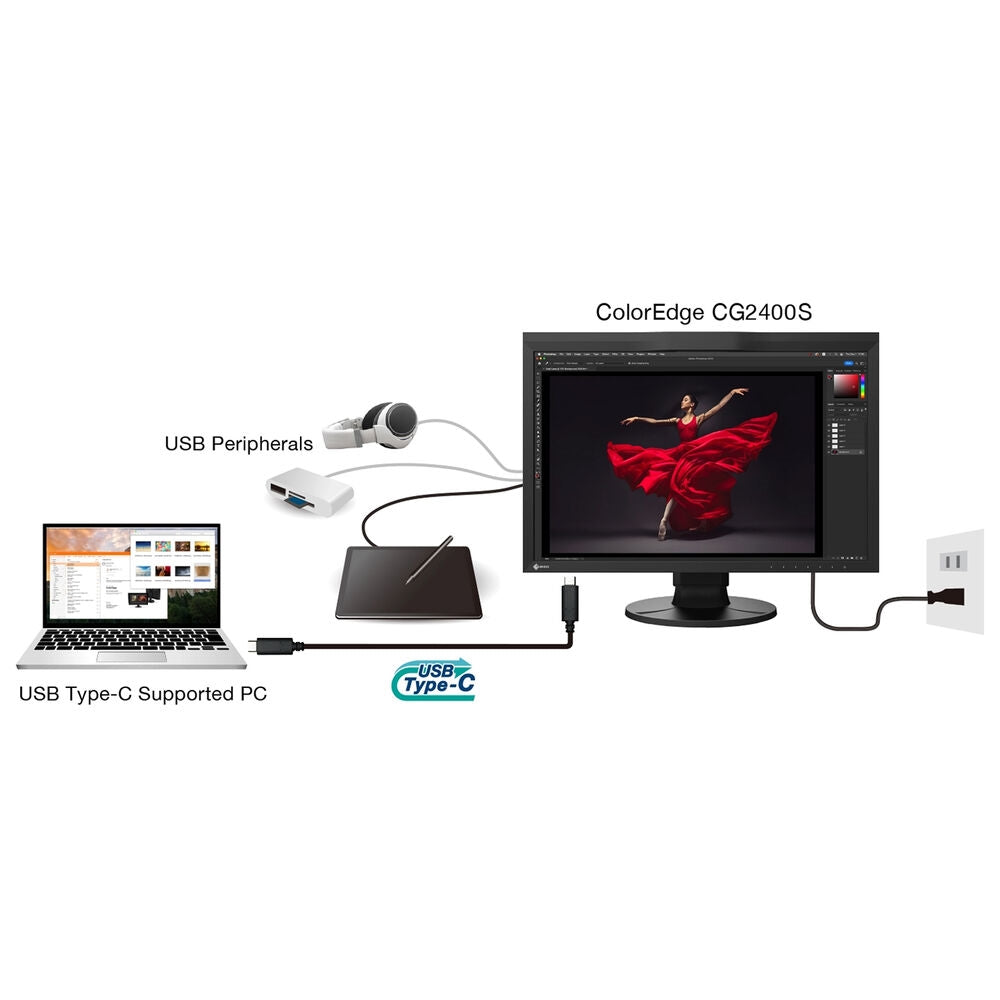
Alongside its compact design, linking a compatible laptop to the USB-C port enables the transfer of video, data, and up to 70W of power using just one cable. Additionally, HDMI and DisplayPort inputs are provided. Utilize the integrated USB hub to connect flash drives, keyboards, mice, and various other peripherals via the monitor. The monitor hood that comes with the package assists in eliminating distracting light, allowing you to achieve the ideal appearance.
- With a 1920 x 1200 resolution and 16:10 aspect ratio, you more vertical viewing space than traditional Full HD displays, which can reduce the amount of scrolling.
- The 24.1" IPS panel provides 10-bit color with 99% Adobe RGB and 98% DCI-P3 coverage and a 16-bit LUT. HLG and PQ high-dynamic range support provides sharp contrast with a 1800:1 static contrast ratio and 400 nits brightness.
- This monitor is equipped with a 3D LUT (look-up table) which adjusts colors on an RGB cubic table. Using ColorNavigator 7's film emulation function, users can emulate film color properties from a 3D LUT file.
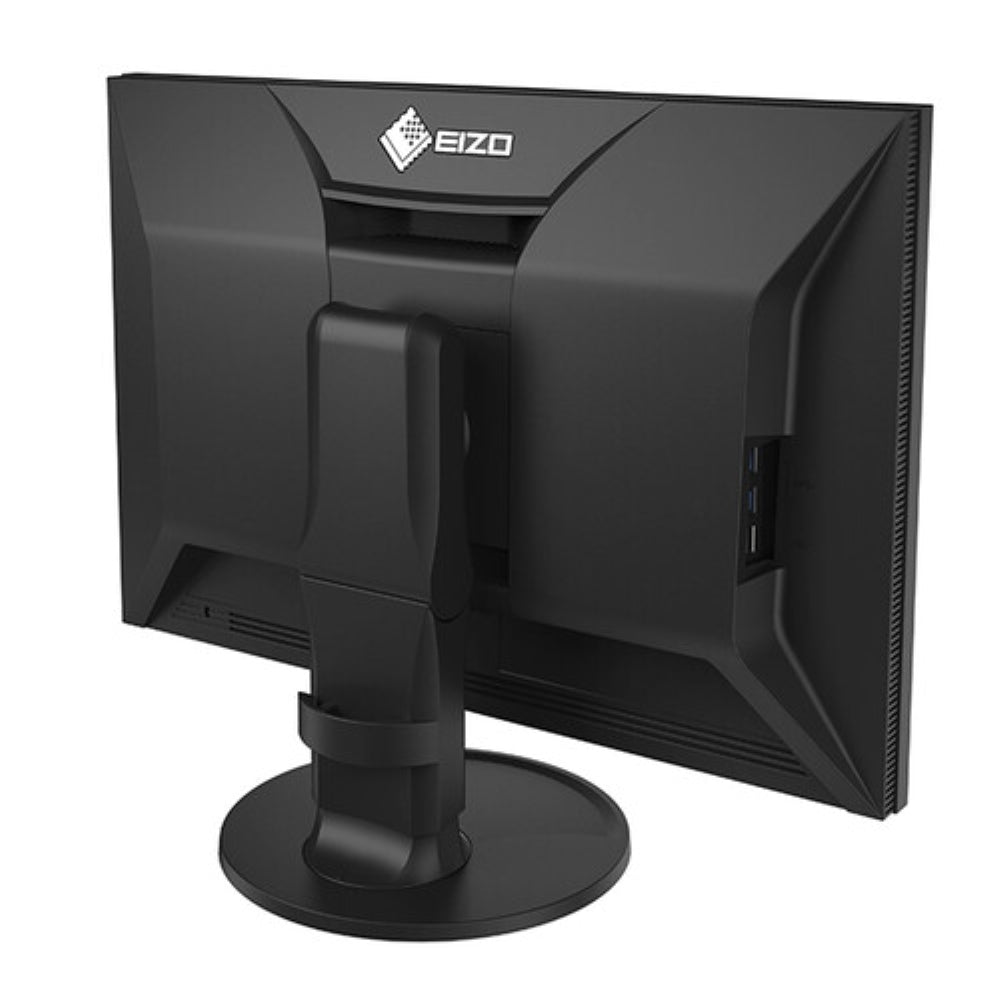
- Two 5 GB/s compatible USB-A 3.2 Gen 1 ports and two USB-A 2.0 ports are located on the side of the monitor for easy accessibility.
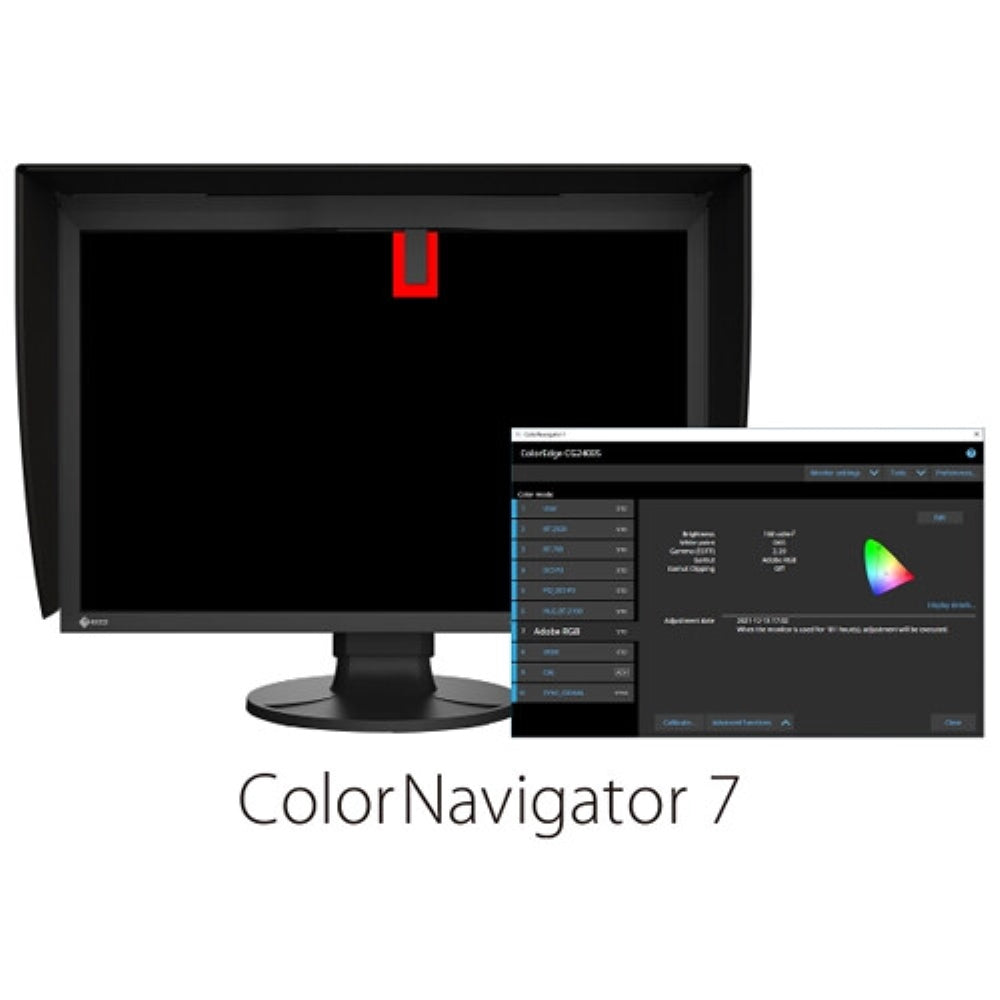
- The integrated sensor is capable of automatically calibrating the monitor at specified intervals. This removes the necessity for an external calibration tool and guarantees that your display remains color accurate. Furthermore, the sensor extends onto the screen, occupying very little space and enabling you to keep working even while calibration is in progress.
- A monitor must undergo calibration at regular intervals to ensure color accuracy. EIZO's exclusive ColorNavigator 7 software offers an intuitive and precise approach to color management. It enables users to schedule automatic recalibrations, calibrate all color modes at once, and perform correlation with external sensors to align with the studio's internal color management system. Calibration data is stored directly on the monitor rather than the operating system, allowing users to avoid recalibration even when switching to a different PC.
- ColorNavigator Network offers centralized quality control (QC) for ColorEdge monitors utilized by studios, printing houses, and various enterprises that have multiple creators and editors collaborating on shared projects. By installing NetAgent or ColorNavigator 7 on the workstation, administrators are able to oversee several ColorEdge monitors through a web browser, facilitating quality control even from distant locations. ColorNavigator Network is hosted on a secure cloud server, relieving you from the initial investment and ongoing expenses associated with maintaining your own server.
- The CG2400S offers preset modes for DCI-P3, BT.709, and BT.2020 to ensure you can work in the appropriate color spaces and gamma values. Additionally, preset modes for PQ (DCI and BT.2100) and HLG (BT.2100) are available for viewing HDR content. With the monitor's built-in calibration sensor, you can adjust or maintain the brightness setting for each preset.
- Support for HLG (hybrid log-gamma) and the PQ (perceptual quantization) curve allows for displaying and editing HDR (high dynamic range) video content. The optimized gamma curves render images to appear more true to how the human eye perceives the real world compared to SDR (standard dynamic range). This ensures professional creators can reliably display HDR content for editing and color grading.
- In compliance with the DCI standard, the monitor offers a high contrast ratio of 1800:1 for producing true blacks that are otherwise difficult to display on a typical LCD monitor. CG Series monitors are also equipped with a retardation film which allows tones to retain their depth, even when viewed from an angle.
- The monitor's Sync Signal function automatically switches the color settings such as brightness, gamma (EOTF), and color gamut according to the metadata of the input signal. This eliminates the need to manually switch color settings when working on multiple projects.
- An optional PQ gamma curve (EOTF) function that allows the input signal to be clipped or compressed to fit within the luminance value of the monitor. This allows users to simulate how the signal will appear in other display environments. The Auto setting under PQ Option menu automatically adjusts the PQ curve according to the monitor's current brightness.
- The PQ Option function allows you to check PQ content at any brightness level and shows the areas of the image that are clipped when displayed at a specified brightness level. These areas are marked in yellow or magenta to easily distinguish them within the image.
- The monitor includes a Gamut Warning preset that, when selected, indicates areas of a BT.2020 image that cannot be reproduced using BT.709 by converting them to shades of gray. An additional mode called BT.709 Clipping allows the editor to view BT.2020 images within the BT.709 color space, simulating how it would look to their audience in an HDTV environment.
- Working within the wrong parameters affects editing decisions, potentially requiring significant rework of projects and causing costly delays in production schedules. Pixel Inspection, operated through the monitor's OSD, shows the color information of a pixel from the source input data and the data as it is displayed on the monitor.
- A marker function ensures that content, such as text or graphics, is properly positioned on the screen. The Safe Area Marker marks an area of the screen within which captions or other information will appear to ensure they are visible during broadcast. The position and size of the markers can be specified to suit the current project.
- The gamma level for each ColorEdge monitor is adjusted at the factory by measuring the R, G, and B gamma values from 0 to 255, then using the monitor's 16-bit look-up-table (LUT) to select the 256 most appropriate tones and achieve the desired value. This ensures the smoothest color gradations in your images.
- LCD monitors commonly exhibit fluctuations in brightness and chromaticity across the screen, affecting color accuracy. To counter this, ColorEdge monitors are equipped with EIZO's patented digital uniformity equalizer (DUE) technology which corrects deviations in every tone across the screen to ensure stable display.
- The hue and luminosity of an LCD monitor may vary as a result of fluctuations in the ambient temperature and the monitor's own temperature. The ColorEdge CG Series monitors come equipped with a temperature sensor that accurately gauges the internal temperature of the monitor while also estimating the temperature of the surrounding environment. Utilizing this technology for temperature sensing and estimation, the monitor makes real-time adjustments to ensure that gradations, colors, brightness, and other attributes are consistently displayed with precision. Additionally, EIZO incorporates artificial intelligence (AI) into its estimation algorithm to identify different patterns of temperature change, allowing for even more precise corrections.
- A typical monitor takes 30 minutes or more for its brightness, chromaticity, and tone characteristics to stabilize. The ColorEdge CG2400S takes a mere 3 minutes soon after turning the monitor on.
- The ColorEdge CG2400S comes bundled with a light shielding hood that effectively prevents glare on the screen caused by ambient lighting. The hood is newly designed to be lightweight and easily attaches to the monitor magnetically without needing to connect separate parts.
- Adjust the screen to a more comfortable angle and reposition it to show your work to a colleague or client. This monitor included stand offers height, tilt, and swivel adjustments. The stand is also equipped with a quick release that allows you to easily remove the screen from the stand with a single touch.
Display |
|
|---|---|
| Size | 24.1" |
| Panel Type | IPS-Type LCD |
| Aspect Ratio | 16:10 |
| Native Resolution | 1920 x 1200 |
| Maximum Brightness | 400 nits / cd/m2 |
| HDR Support | Yes |
| Contrast Ratio | 1800:1 |
| Response Time | 11 ms (GtG) |
| Refresh Rate | 60 Hz |
| Variable Refresh Technology | No |
| Color Support | 1.07 Billion Colors (10-Bit) |
| Color Gamut | 99% Adobe RGB 98% DCI-P3 |
| Curved Display | No |
| Finish | Anti-Glare |
Surface |
|
|---|---|
| Touchscreen | No |
Connectivity |
|
|---|---|
| A/V Inputs | 1x HDMI 1x DisplayPort |
| HDCP Support | Yes: Version 2.3 |
| USB I/O | 1x USB-C 3.0 / 3.1/3.2 Gen 1 with DP Alt Mode, USB PD 70 W 2x USB-A 3.0 / 3.1/3.2 Gen 1 2x USB-A 2.0 |
| Multi-Input Support (PIP/PBP) | No |
Speaker |
|
|---|---|
| Built-In Speakers | No |
Electrical |
|
|---|---|
| Power Consumption | Operational: 17.0 W Maximum: 150.0 W |
| Input Power | 100 to 240 VAC, 50 / 60 Hz |
| Power Adapter Type | Internal |
General |
|
|---|---|
| Operating Conditions | 32 to 95°F / 0 to 35°C at 20 to 80% Humidity |
| Certifications | CB, CE, FCC, ICES, RCM, RoHS, TUV, UKCA, VCCI, WEEE, cTUVus |
| Adjustments | Tilt: 40° (5 to 35°) Swivel: 344° Rotation: 90° |
| VESA Mounting-Hole Pattern | 100 x 100 mm |
| Lock Slot | Yes |
| Dimensions | 22.2 x 21.8 x 9.6" / 563.1 x 554.4 x 245 mm (with Stand) 21.8 x 14.7 x 2.8" / 554.4 x 374.1 x 70.2 mm (without Stand) |
| Weight | 18.7 lb / 8.5 kg (with Stand) 12.1 lb / 5.5 kg (without Stand) |


